

Resistance to change or lack of meaning?
Is it resistance to change or simply a lack of meaning? This is a question we all need to ask ourselves - both as individuals and as organisations.
Let's start with what we all see at the beginning of the year and the dawn of autumn: our LinkedIn feeds filled with announcements of people jumping into new jobs and gyms full of gym-goers starting the second - or maybe tenth - new beginning of their lives. The phenomenon described above is as certain as the cycle of nature.
But why does this happen at certain times? And what does this tell us about change?
It's not resistance, it's a lack of meaning
Many people talk about resistance to change as if it were an inevitable force of nature - but you know what? It's nonsense. People don't really resist change. People are resisting irrelevance.
If someone wants to stay in the old, dull, stultifying dungeon of their (working) life, it's not because the winds of change are blowing too hard. It's because no one has managed to show them why they should care about potential change.
Think about it again: when you decide to start a new job or go to the gym in search of a new phase in your life, you're not just doing it for fun. Underneath it all is a need to find meaning, a need to feel that there is a deeper point to it all.
The same is true in working life. When workers are not enthusiastic about change, it is not because they want to hang on to the old way of doing things. It's because they don't see the point of change.
Change without meaning is like a gym card without use
Change in itself is neither good nor bad - it is inevitable. But the success of change is directly related to how well its meaning is communicated and understood.
Let's take a look at those who go to the gym to work out. Why do those who commit to change stick with it? I'm talking about the ones who don't disappear from the gym every year after starting in January or August, like ashes in the wind. Because they see that that change brings something valuable - health, energy, confidence, presence, etc.
At the deepest level, meaning is found both within and, above all, outside the self. The philosopher Frank Martela has described meaning and purpose in life as follows:
”The meaning of life is to make yourself relevant to other people.”
The 25-year-old supermodel is squatting because she wants to look her best at a wedding in Suomenlinna Castle next summer. That's the one she's been dreaming about for the first quarter of a century. Meaning starts with the self.
A 45-year-old parent (home role) and manager (work role), who is living the life of a rush-hour parent, Sal may want to drop 5-10 kilos from the treadmill to be more present for his family after a day's work. Too many years, a decade in fact, have been spent living as a dead man, a zombie in Finnish, at the wheel of a squirrel wheel and in the cramped confines of everyday life. Enough is enough! Meaning comes from the self and others.
The 61-year-old CEO of a listed company, who is bench-pressing, wants to ensure that he has at least 20 years of life left to see his grandchildren grow up and, through the government job ahead of him, to transform the global working world in a more sustainable direction, both humanly and economically. The meaning comes from other people and the world.
Change without meaning is like a gym card without use - useless. The desired change remains at the green grassless end of the gym on the starting blocks.
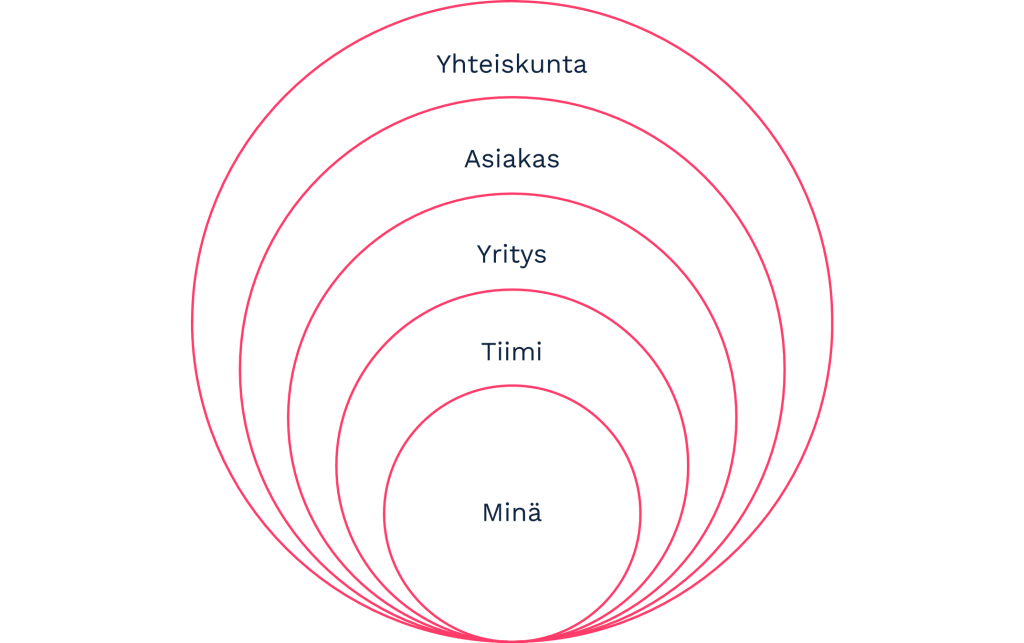
Successful change management in an organisation starts with meaning
This same logic of change and meaning applies to any organisational change project. If employees don't see change as bringing anything meaningful to their lives, their workplace, their customers or the world around them, why would they invest in it?
This has been said so many times and it is certainly worth saying again, at least this time: the leadership of the organisation is responsible for creating and communicating the meaning of change together with its people. If you - as a CEO or change leader - cannot communicate (listen and communicate) why change is important and how it will make everyone's life better, don't be surprised if there is resistance to change.
A good meaningful message answers the following questions:
- Why is this relevant to me?
- Why is this relevant to us (work community/relationships/team)?
- Why is this relevant for your business?
- Why is this relevant for customers?
- Why is this relevant to society?
When meaning is found, there is no need for force or pressure. When employees see how change benefits them, the organisation, customers and the world, they get on board - and do it with their hearts.
So there's no need to push, no need to manipulate. It is enough that the meaning is clear and honest. This same phenomenon is repeated in personal life. Why do some people succeed in their lifestyle changes? Because they have found a deeper (life) meaning. It's not just a superficial decision, but a deep commitment to a better life.
This is a truth we all need to internalise: change is never just external. It is always internal. And this inner change comes from a meaning that, at the highest level, crystallises in other people and in the world.
Without meaning, change is just another attempt to do something different, another new start that dies at the beginning. Be the one who makes change meaningful and, with it, impactful.