
Together with the customer - this is how the sales and marketing interplay will be built
The interplay between sales and marketing has been talked about for ages. Nevertheless, every now and then you hear the phrase ”marketing is just flying through the air and doesn't know anything about sales!” or ”those salespeople are fools not to make good use of our marketing outputs!”. No matter what you do, you can't seem to find a common language... but why?
The problem of centralisation and decentralisation
The bigger the company, the further away sales and marketing from each other often are. Centralised or global marketing aims to achieve efficiency and harmonised messages that support the company's vision and strategy. At the same time, however, it often overlooks adequate support for the day-to-day running of sales. The interplay between sales and marketing is non-existent.
In many international companies, organisational cycles are the order of the day. You centralise, manage, plan and execute in silos and when that doesn't work, you move back to more localisation closer to the customer and you find you're doing the same things in many different places, which is inefficient and inconsistent. Then you centralise again.
Agile sales and marketing interplay across silos
An organisation has a purpose and simply changing the organisation does not necessarily change what you do. Planning and working together across organisational boundaries is the thing. This is easy to say but harder to do.
The will and framework for teaming up around a service or customer needs to be created. It is up to management to encourage agile teamwork. A dream situation would be, for example, virtual teams across silos, where sales, marketing, service management and a technology or industry consultant would manage customer relationships together and cost and hourly accounting as well as remuneration would be managed to support productive teamwork.
The kind of work where a team close to the customer has the power and the budget to decide what kind of customer-specific sales, marketing and service delivery work will result in a satisfied customer. A satisfied customer buys more, is willing to pay more for the service and brings in a higher margin, i.e. more customer profitability.
In this case, the team itself is also responsible for its performance. They have a rich toolbox of business services, management support, experts, a marketing arsenal, technologies such as generative AI and automation, and deep customer and industry knowledge.
How to make co-creation part of everyday life?
It is therefore important to create a model of co-play that is based on a deep understanding of the customer and is able to respond to the customer and market situation - i.e. produce exactly the end results that are needed in the moment. So sales will become more predictable, efficient and customer-focused, resulting in increased cash flow and smarter use of working hours amidst the hustle and bustle of everyday life. This also means that sales and marketing can work together to good effect.
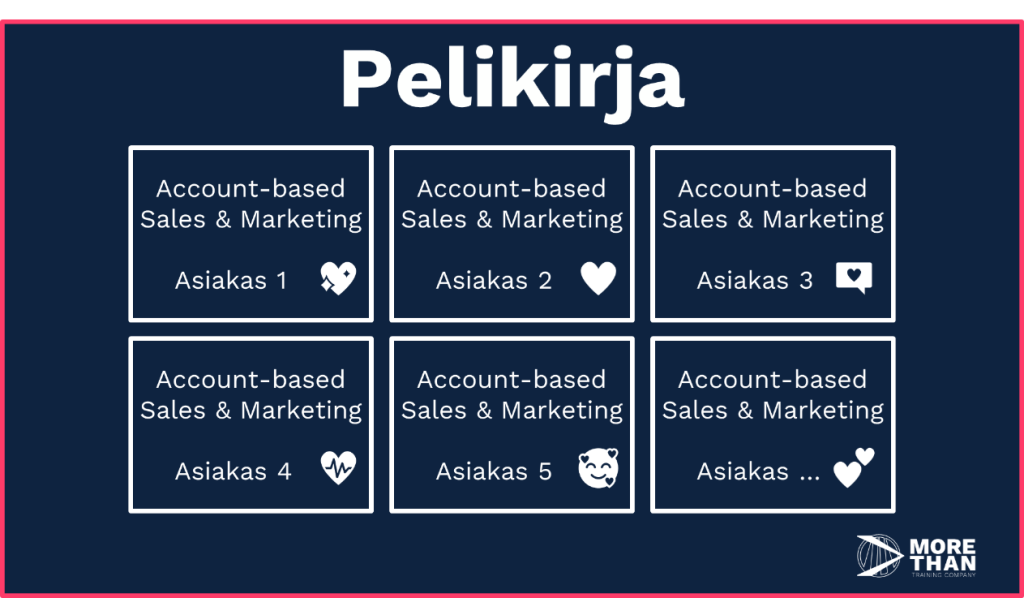
In principle, achieving co-creation is not difficult, just cumbersome. By gamifying key issues such as customer classification and management, sales and marketing, you create a workable framework for agile customer engagement at different stages of the customer journey. These stages can include making the first purchase, growing a partnership or even winning a single project.
Within these frameworks, virtual teams work independently, agilely, efficiently and responsibly to create:
- Develop a marketing and sales plan that supports your strategic and business objectives.
- Customer-specific sales and marketing policies that can be changed and improved quickly based on the customer's situation.
- The customer care model, which delivers good customer satisfaction and profitability, as well as comprehensive customer journey support.
With the support of management, sales and marketing play together to make everyday life easier
It's getting these things into everyday life that's the hard part. Management has an important role and responsibility in bringing about this agile approach.
Effective agile teams across borders should have the power and appropriate resources at their disposal easily without huge bureaucracy. Of course, these teams must also be accountable for delivering results.
What is required is the ability to trust, the willingness to hold individuals to account and the a coaching approach to leadership in everyday life, in order to create the necessary dynamism. Team members, on the other hand, need to have the skills of teamwork and cooperation, so that they can focus on working together towards a common goal, rather than being at odds with each other.
Agile reap the pot
In large and small companies alike, it is easy to become fragmented as the organisation grows. Line organisation also has its advantages. However, today's organisations do not have to define everything they do. It is possible to build agile, cross-boundary models.
Agile or Agile sales and marketing working together around customers and their individual needs is the key to simultaneously achieving satisfied customers and happy, well-paid sales and marketing professionals. And, of course, the company benefits in the form of increased customer profitability at the same time.