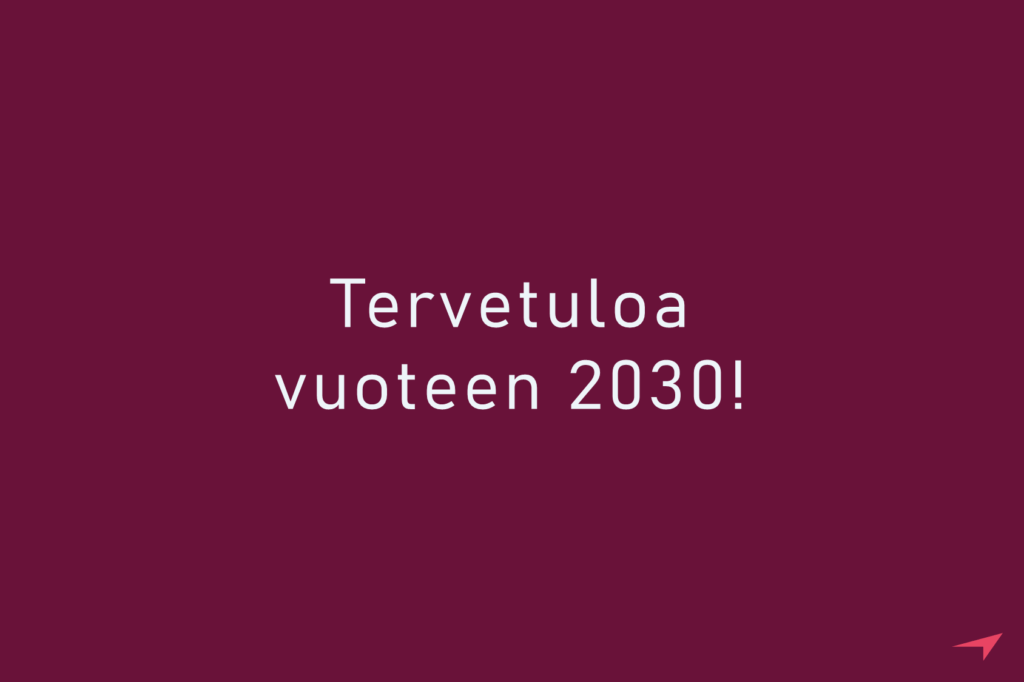
Welcome to 2030! - A futures game to test the strategy's effectiveness in a changing world
The year is 2030. The fierce great power competition of the late 2020s has left its mark: the EU has distanced itself from the US, the Ukraine conflict is frozen without resolution, and the West's relations with Russia are practically non-existent. Since the 2028 elections, Washington has taken a more moderate course and transatlantic tensions have begun to ease.
Global economic growth is slow and uneven. Emerging markets drive the global economy, while the major powers - the US, China, the EU and Russia - compete for resources and influence, particularly in Africa, Latin America and Asia.
The effects of climate change are worsening, environmental policy is fragmented, and the EU is going its own way with tighter regulation and emissions trading mechanisms. The world has not collapsed, but no one knows where it is going either.
The Futures Game - a way to visualise the consequences of strategic choices
Strategy work there is one classic fallacy: the idea that careful enough analysis can lead to control of the future. Organisations spend months refining their choices, scenarios are plausible and the arguments hold up - and yet, in a few years' time, the reality looks very different from what any film dared to claim.
That doesn't mean the job was done badly. It means that the world is more complex than any plan.
From this starting point, we at More Than Group have become more interested in the question than in any single strategy tool: what if the strategy was not just planned, but practised??
2030, two teams, one difference
We recently designed an exercise for a client, which we simply call a futures game. In all its simplicity, it is a game that simulates changes in the business environment, requiring participants to think strategically and make choices in the midst of change.
The starting point was simple, at least on the face of it. It's 2030. The market has changed: competition has intensified, the industry has consolidated, new global players have challenged the old players. Technology has advanced, but it hasn't solved everything.
Participants were divided into two teams. Both started from an identical situation. There was only one difference: the strategic choice. One team led the organisation towards one future, the other towards another.
Information overload, decisions, consequences in the future game
The game progressed in annual rounds. Each started in the same way: teams got hold of news, market rumours, competitor movements, regulatory changes. Some of the material was substantive. Some of it was an illusion. Some of it was something in between - just like real life.
The task was not to analyse everything perfectly, but to decide what was relevant and act on it.
Then the choices were made. To invest or to save? Expand or focus? Do you build the know-how yourself or buy it? Do we react to a competitor's move or force a competitor to react to us?
After that, the world moved. Competitors made their moves, the market changed, and the consequences of those decisions began to be felt. After each round, participants critically evaluated the choices they had made and how they were affected by the changing world.
The aim is to deepen strategic thinking by playing with the future
The game does not reveal who came up with the best strategy, or ”which team won”. Instead, the end result is observations such as which world changes had a greater impact on either strategic choice, and which had a major impact on both.
The game's reward is not only the strategic discussion during the game itself, but also the collective reflection after the game. In the best case, the game offers a new way of thinking about the strategic choices a company should make and the kinds of situations it should prepare for.
Of course, we cannot simulate all possible worlds and their changes, but with a comprehensive analysis of the key future uncertainties affecting the company's success in the background, we can discuss their cross-impacts and probabilities in the future.
Future game puts strategic issues to the test
We often think that the success of a strategy depends on making the right choices at the outset. In reality, it is rarely the whole story. More often the strategy falls down because decisions are not made in time, the organisation is afraid to commit to something, or people do not share a common vision of the situation.
More Than Group's future game makes this visible in a matter of hours, condensing years of learning into a single experience.
It works because it bypasses the biggest pitfall of strategy work: abstraction or vagueness. In the boardroom, we talk about concepts: growth, competitive advantage, customer value. In the game, strategy becomes action, and action becomes consequence. Suddenly, the question is no longer ”what would make sense to do” but ”what are we really doing, and why”.
The future cannot be predicted. But you can prepare for it. If you want to test your strategy in a changing future, contact us!
Samaan aiheeseen liittyvää
- An organisation ready for the future
- What does uncertainty about the future mean to you?
- The Technology Industry Association is launching a project to develop foresight capabilities in collaboration with More Than Strategy and the Futures Platform
- Resilience in an organisation – how to develop the ability to cope with uncertainty