What does an organisation that is really ready for the future look like?
Many of us do something ’for the future’, for example, I save and invest, study more, and try to keep abreast of changes in the world and think about how they might affect my future. My spouse and I have ideas about what kind of renovations we should do and when. Our children are of a certain age and we can anticipate when there will be transitions in their lives.
Also, in the vast majority of organisations, things are being done for the future. Identifying megatrends, making scenario work, updated strategy. At the same time, however, it seems that surprisingly few organisations are really ready for the future. The explanation is simple - the problem is not a lack of information, but the way the organisation operates on a day-to-day basis..
Future readiness is, in my view, a set of everyday behaviours that appear in an organisation, especially when the situation is unclear, unfinished and perhaps uncomfortable as a result. The following five questions will help you to reflect on how prepared your organisation is to face even the most unexpected changes in the future environment.
Question 1: How quickly do you make decisions without full information?
Many organisations say they are data-driven, which is of course a good thing. The challenge comes when the practice becomes one of deferring decisions until there is enough data. Do you really need a new study, report or task force to move forward, or would it be better to make a decision with slightly less certain data, and correct if necessary?
Organisations that cope with uncertainty make good enough decisions quickly, and correct direction on the move. Others are left waiting for certainty that may never come.
Question 2: How do you decide what to stop doing and when?
Unfortunately, few organisations can answer this question. Almost all have openings, innovations and development programmes. At the same time, nothing really stops. In the worst case, the plans and programmes just fade into oblivion and are gradually swept under the carpet. Do you have an idea of how and when you decide to stop doing something? What to stop?
The key to future readiness is the ability to let go. Organisations that do not systematically (at least consciously) free resources from the old will not make room for the new.
Question 3: How quickly did you learn?
In many organisations, there is a ’culture of experimentation’ in the talk. In practice, however, experimentation is lame - slow, cumbersome, unclear. A pilot can last for months, and in the end no one really knows what was learned, or what to do next.
In a future-ready organisation, learning is a rapid cycle: quickly from idea to experiment and from experiment to decision. Understand what you are really trying out, what lessons are being sought, and define in advance, within certain limits, the kinds of results that will be successful. In this way, we do not go down the road of seeing what happens and then deciding whether it is useful.
The idea is (roughly speaking) to test, for example with A/B testing, whether this will bring the desired benefits. ’Any benefit’ is not good enough if it is not assessed against objectives and opportunity costs.
Question 4: How is your strategy reflected in your day-to-day work (and is it consistent)?
If you ask middle management in your organisation what strategy means in their day-to-day work, will you get a single answer, or ten different interpretations?
The future is not made in days of strategy, but in thousands of small decisions in the midst of everyday life. An organisation is only ready for the future when people are able to make independent decisions that are in line with the chosen direction (without escalating every issue to a higher level ’just in case’).
Question 5: Do you dare to disagree?
There is a good spirit in many teams and organisations. Again, in the big picture, this is a good thing. Challenges arise if, in order to maintain good spirit (or for some other reason), dissenting views are not wanted to be expressed. In such cases, decisions appear unanimous but may not be based on a true picture of the situation or take into account critical issues.
In a future-ready organisation, conflict is not a threat, but a resource to be actively exploited. The aim is not (of course) to seek total certainty and knowledge, but to identify what is relevant, to consciously and deliberately challenge decisions that seem too consensus and ’right’, and to ensure that our decisions are based on considered assumptions, not on the first option.
Towards a future-ready organisation
These questions are the key to a future-ready organisation. This is not an exhaustive list, nor is it based on complete knowledge (😉), but let's say that organisations that can make decisions in the face of uncertainty, that ensure that the old can be abandoned when necessary, that strive to learn quickly, whose strategy is reflected in their everyday choices, and where people dare to disagree, are significantly better prepared to meet the challenges of an ever-changing environment than organisations where these have not been considered or where they are ’a bit off’.
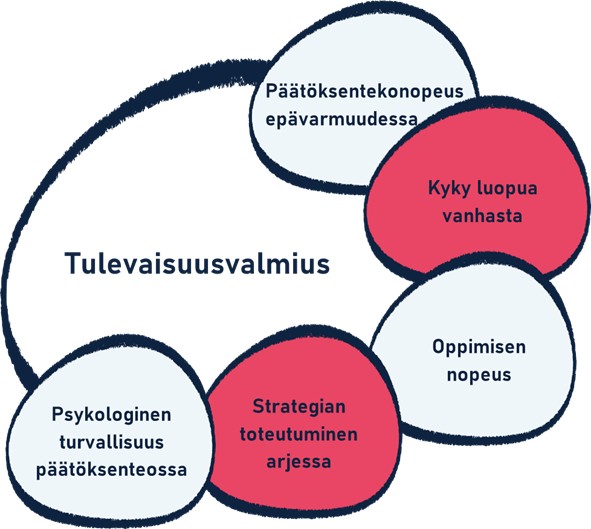
Most organisations also identify these areas of preparedness. The question is, are you already acting on them?
For organisations, the future is not primarily a problem of analysis. Information is increasingly available. Therefore, it is not enough to know what is coming. What matters is whether you can change before you have to.
In case you are wondering, let's talk more.
Related to the same topic
- More Than Golf 2026 – What will Finland look like in 2086?
- What does uncertainty about the future mean to you?
- The Technology Industry Association is launching a project to develop foresight capabilities in collaboration with More Than Strategy and the Futures Platform
- More Than Group and Futures Platform launch strategic partnership